
1. Recruitment and onboarding costs

Recruitment and onboarding are processes that require significant financial and time investment.
Recruitment:
- Costs of posting job advertisements on recruitment platforms or social media.
- Time spent by recruiters or HR teams on reviewing applications and conducting interviews.
- If collaborating with recruitment agencies, commission fees can range from 10% to 30% of the candidate’s annual salary.
Onboarding:
- Organizing introductory and onboarding training sessions.
- Reduced efficiency of other employees involved in onboarding the new hire.
- The risk that the investment in the employee’s development will be wasted if they turn out to be unsuitable.
2. Reduced productivity

An unsuitable employee not only delivers poor performance but also negatively impacts the rest of the team.
Poor work performance:
- Longer task completion times and a higher number of errors.
- Lack of initiative and engagement, which can lead to delays in project execution.
Impact on the team:
- Other employees may need to take over tasks, increasing their workload.
- Frustration and a decline in team morale, especially when the employee fails to collaborate or meet expectations.
Example:
A technology company that hired an inexperienced programmer experienced delays in completing a critical project, ultimately leading to the loss of a key contract.
3. Termination and replacement costs

The decision to terminate an employee comes with the need to restart the costly recruitment process. Additionally, the company loses the time and resources invested in the employee’s development.
Employee Termination:
- Legal formalities associated with terminating a contract may involve additional costs (e.g., severance pay).
- Repeating the entire recruitment and onboarding process.
Employee Resignation:
- In cases of sudden resignation, costs arise from the disruption of work continuity.
- Delays in projects often occur when immediate replacements are required.
4. Financial costs

An employee who doesn’t add value to the company generates both direct and indirect losses.
Errors:
- Result in financial losses, such as costs for correcting mistakes, compensating clients, or a decline in product quality.
Loss of Clients:
- An employee with inadequate skills in customer service can negatively affect the customer experience, leading to client attrition.
Example:
Poor sales decisions made by an incompetent salesperson led to the loss of key business partners, costing the company significant revenue.
5. Reputational costs

In today’s world, where customer and business partner opinions spread quickly online, a company’s image can suffer due to the actions of a single unsuitable employee.
Example:
An employee who behaved unprofessionally toward a client on social media caused a wave of negative comments and a boycott of the company.
6. Manager’s time

Managers spend additional time supervising incompetent employees—time that could otherwise be dedicated to team development or executing strategic projects.
7. Impact on organizational culture

An unsuitable employee can weaken the company’s organizational culture by creating tensions within the team or undermining the company’s values through their behavior.
Example:
A person who disregards teamwork principles can cause conflicts, demotivate others, and reduce the overall effectiveness of the group.
Estimated costs
In practice, it is estimated that the cost of hiring an unsuitable employee can range from 30% to as much as 200% of their annual salary, depending on the position and the nature of the work. The most significant losses are observed in high-level positions.
How to prevent recruitment mistakes?
Accurate definition of requirements
Clearly define the technical and soft skills required for a given position right in the job posting. You can use our generator to help with this process.
CV selection based on data
It is incredibly important that the selection of candidates advancing to the next stage of recruitment is based on data, not the recruiter’s intuition. Recently, three types of tools have emerged on the market to assist with CV selection:
- Application forms – they allow for the rejection of candidates who provided incorrect answers (e.g., the job posting requires C1-level English, but the candidate indicated B2-level proficiency in the survey). Candidates are reluctant to fill out lengthy forms. It’s important to limit the number of questions to a minimum.
- Skills tests – These are completed by candidates instead of reviewing their CVs. The idea is that even a candidate with no experience but possessing the required skills should be rated higher than a candidate with years of experience but lacking the necessary skills. Unfortunately, in the era of ChatGPT, such tests have lost their effectiveness, as they can be easily cheated. As a result, you may end up hiring a candidate who lacks both experience and skills.
- CV assessment tools – These calculate a candidate’s suitability for a position based on criteria such as skills, experience, distance from the workplace, and English proficiency. They then present the candidates ranked from best to worst in a clear table.

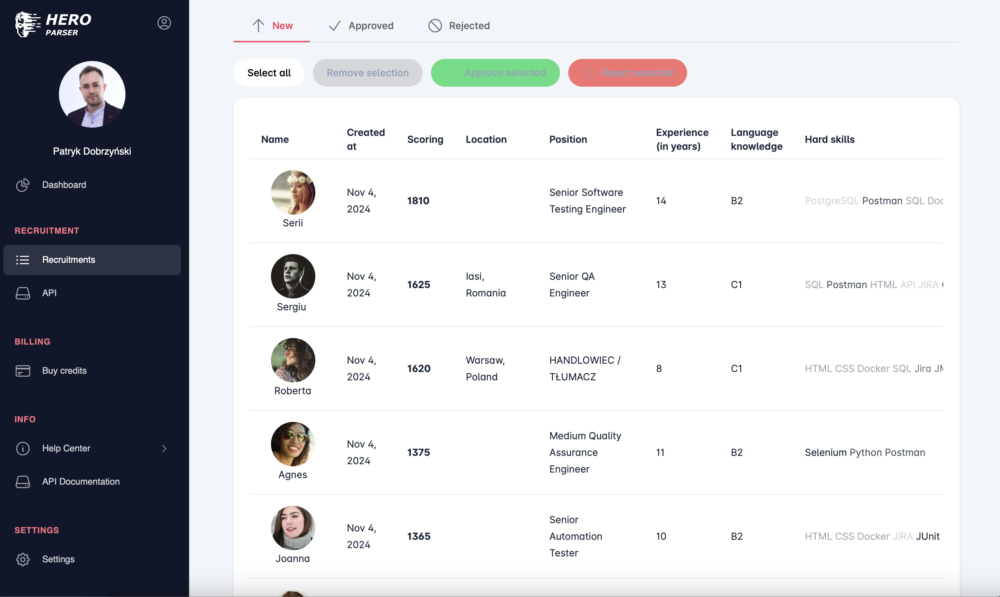
Check which tools your team is using and ensure that the CV selection process is optimized.
Skills testing
Foreign language proficiency can be assessed online, while hard skills verification should take place in the office to minimize the risk of cheating.
Cultural fit assessment
Aligning a candidate’s values with the company’s organizational culture is crucial. Hiring someone who has only worked in large corporations for a small organization might not be the best idea. Such a person may work at a different pace, placing greater emphasis on work-life balance rather than rapid growth. When your company is larger, an individual employee will need to adapt to the rest of the team. However, if you’re at the early stages of shaping your organizational culture, such a person could significantly influence its final form.
Trial period contract
Long notice periods at the start of a collaboration are not the best idea. A 2-3 month trial period works best, during which the contract can be terminated early if the candidate fails to meet expectations.
Conclusions
The cost of hiring the wrong employee can be much higher than it might seem. Therefore, it is worth investing in proper recruitment processes and tools that minimize the risk of making a mistake. In the long run, this benefits not only the budget but also the efficiency and stability of the organization.
One solution is to refine the CV selection stage, which can be significantly faster and more accurate with tools like Hero Parser. Select the best candidates for initial interviews and reduce the risk of hiring the wrong person.